Ask five different web developers which CMS is “best” and you’ll probably get five different answers, each defended with equal confidence. It’s one of the more confusing decisions small business owners face, mostly because the “best” answer genuinely depends on your business — not on which platform a particular developer happens to prefer working with.
If you’re a small business in Ahmedabad trying to make sense of your options, here’s a straightforward look at the CMS platforms actually worth considering, and who each one suits.
What a CMS Actually Does, in Plain Terms
A content management system (CMS) is the software behind your website that lets you add, edit, and organise content — text, images, product listings, blog posts — without needing to touch code every time you want to make a change.
Without one, updating your website means calling a developer for even small changes, like updating your business hours or adding a new service. With a good CMS, your team can handle most of that themselves.
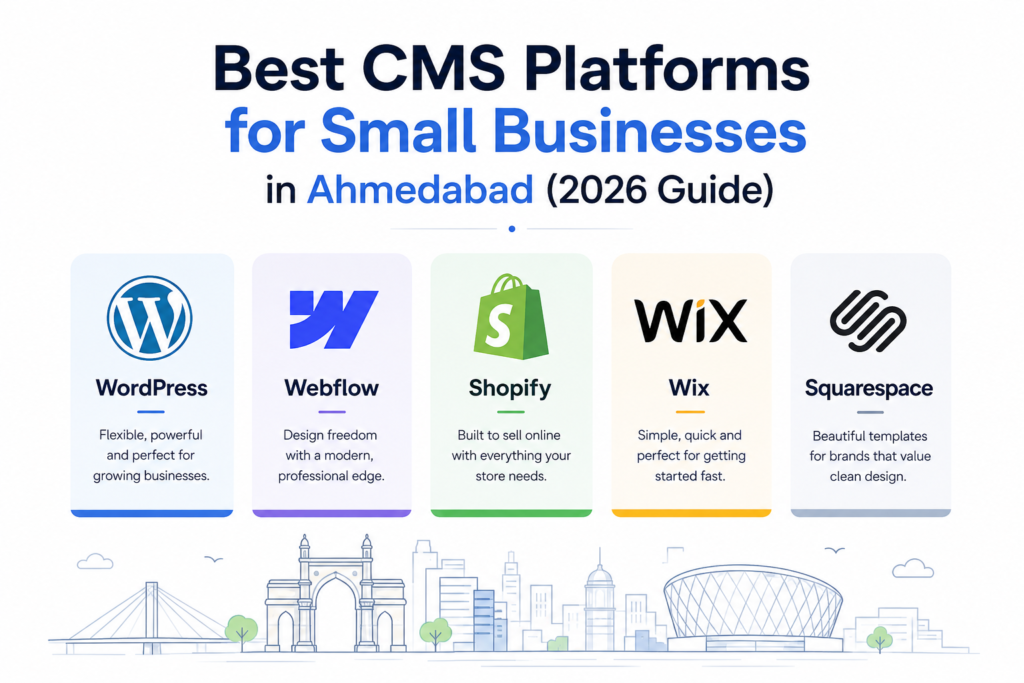
1. WordPress
WordPress remains the most widely used CMS globally, and it’s still the default choice for most Ahmedabad small businesses — for good reason.
Best for: Service businesses, professionals (CAs, lawyers, consultants), businesses that plan to publish content regularly, and anyone who wants long-term flexibility without being tied to one company’s ecosystem.
Strengths:
- Free and open-source at its core, keeping costs manageable
- Enormous ecosystem of themes and plugins for almost any functionality you might need
- Plenty of local developers in Ahmedabad who know it well, so finding support isn’t hard
- Strong SEO capability when built and configured properly
Watch out for: A WordPress site is only as good as how it’s built. Cheap, plugin-heavy builds tend to be slow and harder to maintain. It needs regular updates and basic security maintenance — either through an agency or a maintenance plan.
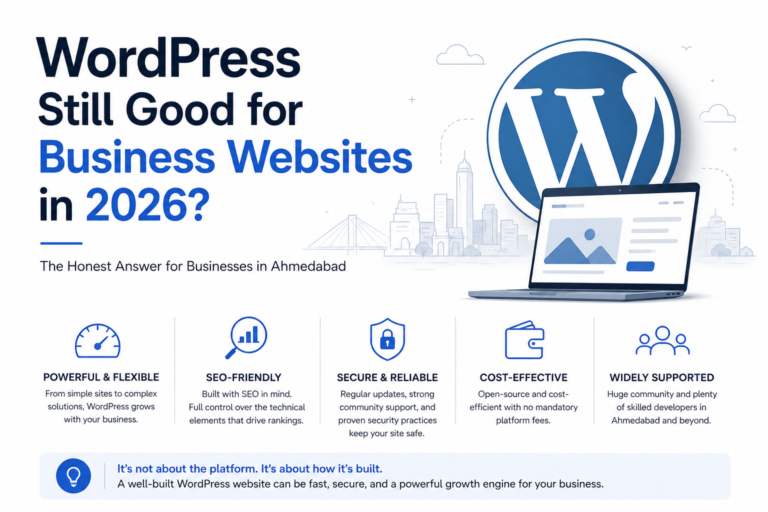
We’ve written a deeper, honest look at whether WordPress still holds up against newer competitors in is WordPress still good for business websites in 2026.
2. Webflow
Webflow has carved out a strong niche among design-conscious businesses that want a highly polished look without needing a developer for every visual tweak.
Best for: Design studios, boutique brands, architecture and interior design firms — businesses where visual presentation is a major part of the pitch.
Strengths:
- High level of design control without writing code
- Hosting, security, and performance are bundled in, reducing technical overhead
- Clean, modern output that doesn’t look templated when done well
Watch out for: Monthly costs that add up over time, a steeper learning curve if you want to manage it yourself, and fewer local Ahmedabad developers who specialise in it compared to WordPress.
3. Shopify
If your small business is primarily about selling products online, Shopify is built specifically to remove the technical burden of running a store.
Best for: D2C brands, boutique retail stores expanding online, and any business where e-commerce is the core function of the website, not an add-on.
Strengths:
- Inventory, payments, shipping, and tax handling are built in
- Reliable uptime and security without managing servers
- Strong ecosystem of apps for marketing, reviews, and multi-channel selling
Watch out for: Monthly fees plus transaction charges that can affect margins for smaller stores, and it’s not designed for content-heavy needs like a large blog or detailed resource pages.
For a full breakdown of how these three stack up against each other directly, see WordPress vs Webflow vs Shopify.
4. Wix
Wix is often the starting point for very small businesses and solo entrepreneurs who want something live quickly without hiring anyone.
Best for: Freelancers, very small local businesses, and anyone who needs a simple, functional website fast and plans to manage it entirely themselves.
Strengths:
- Genuinely easy to use, even with zero technical background
- Affordable entry-level plans
- Reasonable built-in templates for simple use cases
Watch out for: Limited flexibility as your business grows, and switching away later usually means starting over rather than migrating your existing site.
5. Squarespace
Squarespace sits in a similar space to Wix but tends to appeal to businesses that want a slightly more design-forward look without much effort.
Best for: Small creative businesses, personal brands, and portfolio-style websites where clean visual presentation matters more than complex functionality.
Strengths:
- Attractive templates that look professional out of the box
- Straightforward to manage without technical help
- Decent built-in blogging functionality
Watch out for: Less flexibility for custom functionality compared to WordPress, and a smaller local support ecosystem in Ahmedabad specifically.
So Which One Should a Small Business in Ahmedabad Actually Choose?
Here’s a simple way to narrow it down based on what your business actually does:
- Service-based business that wants to grow content and SEO over time? WordPress is usually the strongest long-term choice.
- Design-led brand where visual impression is everything? Webflow is worth the investment.
- Selling products online as your primary business? Shopify removes the most friction.
- Very small business, tight budget, need something live fast? Wix or Squarespace can work as a starting point.
None of these are permanent decisions carved in stone, but switching platforms later does involve real cost and effort — so it’s worth thinking a couple of years ahead rather than just solving for today.
A Note on the “No-Code vs Custom” Question
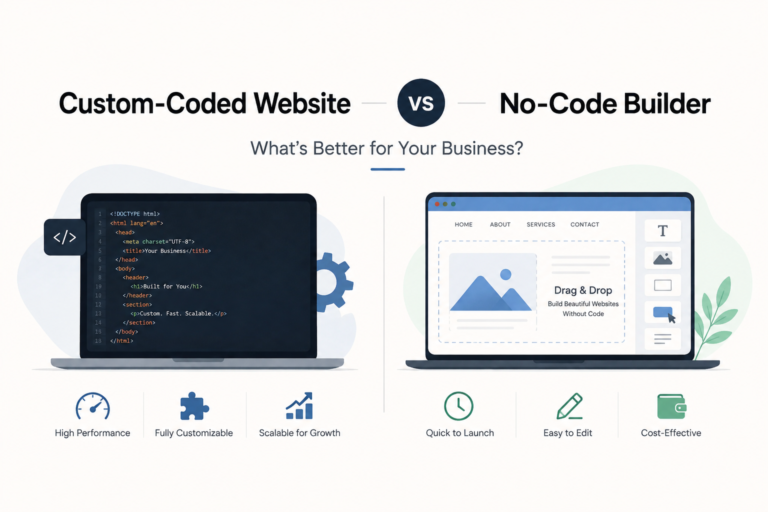
All five platforms above fall on the more accessible, template-driven end of the spectrum. If your business has outgrown what these platforms can offer — or you know from the start that you need something more tailored — it’s worth understanding how a fully custom-coded build compares. We’ve laid that out in custom-coded website vs no-code builder.
The Bottom Line
There’s no single “correct” CMS — only the one that fits what your business needs to do right now, and where it’s realistically headed in the next couple of years. Most small businesses in Ahmedabad don’t need the most powerful or most fashionable platform; they need one that’s reliable, easy to manage, and built properly on top of whatever platform they choose.
If you’re stuck deciding, the platform matters far less than how well the site is actually built and maintained on top of it. At Bison Media, we help Ahmedabad businesses pick the right CMS for their specific goals — not the one that’s easiest for us to sell.