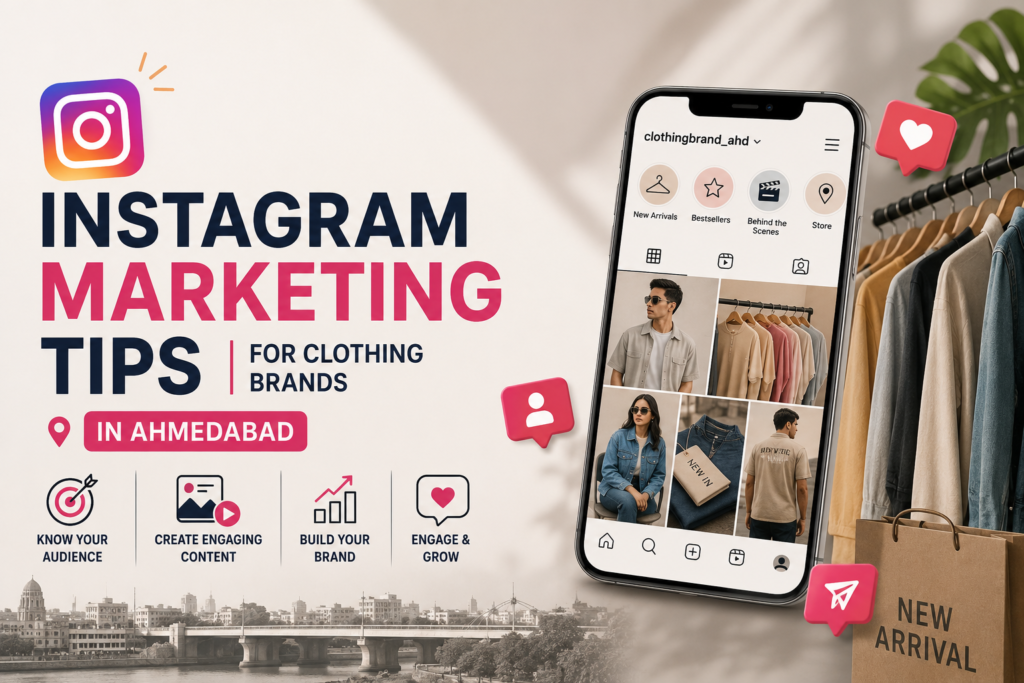
Ahmedabad has one of the most competitive clothing markets in Gujarat right now. Between C.G. Road boutiques, Law Garden’s bridal wear crowd, SG Highway’s westernwear labels, and a growing wave of home-grown D2C brands shipping pan-India from here, every clothing business in this city is fighting for the same scroll. Good products aren’t enough anymore. If your Instagram isn’t doing real work — turning followers into paying customers — you’re leaving money on the table while a competitor with a weaker collection but a sharper page outsells you.
We’ve worked with several clothing and fashion brands on their Instagram strategy, and the same patterns keep showing up: brands that grow fast do a handful of things consistently well, and brands that stall out are usually making one or two fixable mistakes. Here’s what actually works, without the fluff.
1. Stop Posting Product Photos Like a Catalogue
The single biggest shift we see when a clothing brand’s Instagram starts performing is when they stop treating the feed like an online catalogue and start treating it like a magazine.
A plain photo of a kurta on a hanger against a white wall tells people nothing about how it looks on a body, how it moves, or who it’s for. It’s information, not desire. And Instagram is a desire-driven platform — people buy because something made them feel a certain way, not because they compared specifications.
What performs better:
- Photograph the same outfit in two or three ways: on a model in motion, styled with accessories, and a close-up on fabric and stitching detail
- Show real draping and movement, especially for sarees, dupattas, and flowy silhouettes — a static photo undersells fabric that’s meant to move
- Use consistent lighting and a recognizable visual style so your grid is instantly recognizable when someone scrolls past
- Rotate between studio shots and real-location shots (a heritage pol in the old city, a rooftop, a cafe) — location-based shoots do noticeably well with Ahmedabad audiences because the backdrop feels local and relatable
If your grid could belong to any clothing brand in India, that’s the actual problem, not your product.
2. Use Reels for Discovery, Not Just Trends
Most clothing brands in Ahmedabad are on Reels now, but a lot of that effort goes into copying whatever trending audio is popular that week, with the product barely visible in the first three seconds. That’s a wasted Reel. Instagram pushes Reels harder than any other format right now, which makes this the single highest-leverage place to get new eyes on your brand — but only if the content earns the reach.
What actually works for clothing brands specifically:
- Get-ready-with-me and outfit transition Reels — these consistently perform well because they show fit and movement, the two things a photo can’t
- Behind-the-scenes content: fabric sourcing, tailoring process, a look at your Ahmedabad workshop or store — this builds trust, especially for higher-priced or bridal wear
- Styling Reels — “3 ways to wear one kurta” or “how to style this for Navratri” type content gets saved and shared, which Instagram rewards heavily
- Show your face or your team’s face occasionally. Faceless brand pages plateau faster — people buy from people, even in fashion
Trending audio is fine as a layer on top of good content. It should never be the entire strategy.
3. Make Shopping Frictionless Inside the App
This is where a lot of Ahmedabad clothing brands lose sales they’ve already earned. Someone sees a Reel, loves the outfit, taps the profile, and then has to figure out — is this available? What sizes? Do I DM you, is there a website, is this even for sale or just for show?
Every extra step between “I want this” and “I bought this” loses you customers. Fashion buying is impulsive; if it isn’t easy in the moment, that customer moves on to the next Reel and forgets you.
Fix this with:
- Instagram Shop set up properly, with products tagged directly in posts and Reels
- A bio link that goes straight to a shop or a simple catalogue, not just “DM to order”
- Clear size and price info in captions or comments so people aren’t stuck asking
- A fast, templated DM response system for order queries — slow replies are one of the most common reasons a highly interested customer just gives up
If you’re a bigger label, WhatsApp catalogue integration alongside Instagram checkout works particularly well for Ahmedabad’s buying habits, since a lot of local shoppers prefer to confirm sizing over chat before paying.
4. Lean Into Local, Not Just National, Identity
A lot of Ahmedabad clothing brands try to look like they could be based in Mumbai or Delhi, assuming that reads as more premium. It often backfires. Ahmedabad has a strong, specific fashion identity — festive wear around Navratri, wedding season volume, a growing westernwear crowd among college students near Law Garden and Navrangpura, and a market that responds well to brands that feel proudly local rather than generic.
Practical ways to do this:
- Tag your location on every post and story — this helps both human discovery and local search, since Instagram and Google both use location signals
- Create content around Ahmedabad-specific occasions: Navratri collections, wedding season lookbooks, college fest outfit guides
- Collaborate with Ahmedabad-based micro-influencers and stylists rather than only chasing big national names — a local voice with a genuinely engaged following converts better than a large but disconnected one
- Mention your store location clearly if you have a physical outlet — “visit us in Navrangpura” type CTAs drive real footfall, not just profile views
Being from Ahmedabad and owning that, rather than hiding it, is a strength in this market, not a limitation.
5. Track What’s Actually Selling, Not Just What’s Getting Likes
This is the mistake that quietly costs the most money over time. A lot of clothing brands judge a post’s success by likes and comments, when the metric that actually matters is which content drives DMs, link clicks, and sales.
A styled Reel with a trending song might get thousands of views and very little buying intent behind it. A plain but well-shot product photo with clear pricing might get a fraction of the views but convert at a much higher rate. Without checking Instagram Insights regularly, brands keep making more of the content that looks good and less of the content that actually sells.
What to check monthly, at minimum:
- Which post formats (Reels vs. carousels vs. single photos) are driving the most profile visits and link clicks, not just views
- Which products get the most saves — saves are a stronger buying-intent signal than likes
- Story completion rates, to see where people are dropping off in your story sequence
- Peak activity times for your specific audience, so you’re posting when Ahmedabad shoppers are actually online, not on a generic schedule
Vanity metrics feel good. Conversion metrics pay the bills. Building the discipline to check the second set regularly is what separates clothing brands that scale from ones that stay stuck at the same follower count for years.
The Bottom Line
Instagram success for clothing brands in Ahmedabad isn’t about posting more — it’s about posting with intent. Magazine-style visuals instead of a catalogue, Reels that show fit and movement instead of chasing trends blindly, a shopping experience with zero friction, a proudly local identity, and a habit of tracking what converts instead of what just looks good. None of this needs a massive budget. It needs consistency and a clear strategy behind every post.
If you’re running a clothing brand in Ahmedabad and want a straight, no-fluff review of what’s working and what isn’t on your Instagram right now, that’s exactly the kind of audit we do at Bison Media.